Probably not better than placebo. Saw palmetto is the most famous prostate ingredient in the world, and the most tested. The gold-standard 2023 Cochrane review of 27 trials (4,656 men) found little to no improvement in urinary symptoms versus placebo. It is, however, remarkably safe.
Walk down any supplement aisle in America and you'll find saw palmetto in nearly every bottle marketed to men over 50. Annual sales run in the hundreds of millions of dollars. So it's fair to ask a blunt question: does the science back the shelf space? We read the trials so you don't have to. Short version: this is one of the most interesting evidence stories in all of men's health, and it doesn't end the way the labels suggest.
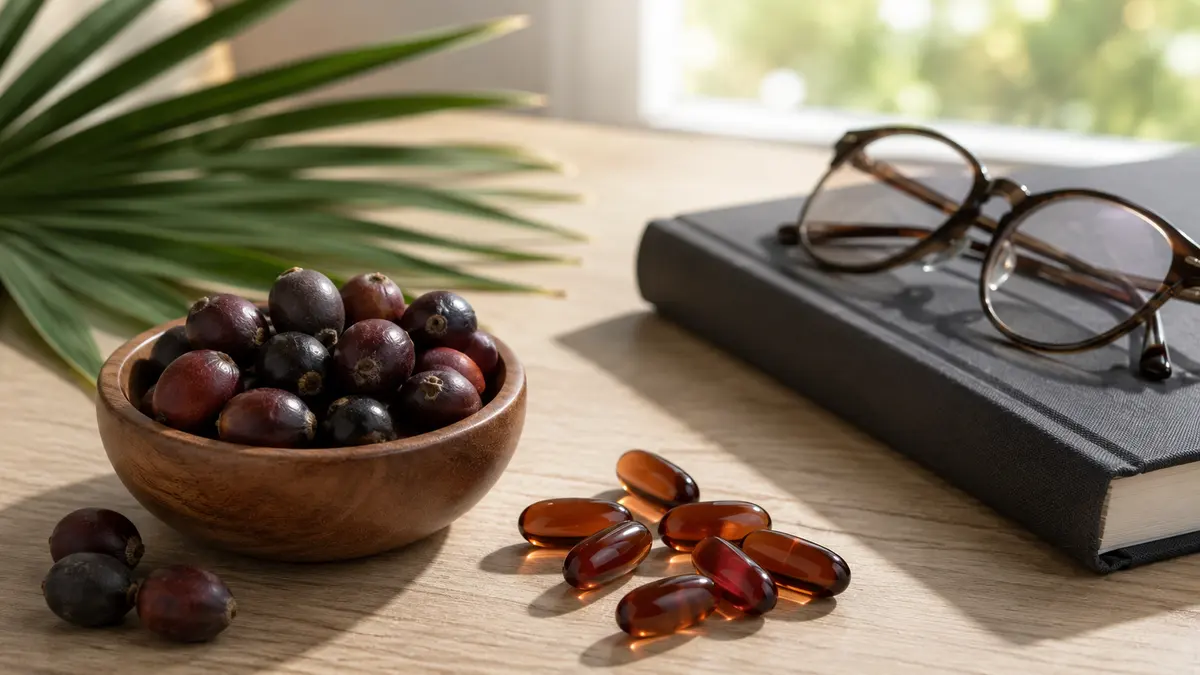
Saw palmetto at a glance:
| Question | Short answer |
|---|---|
| Does saw palmetto work for BPH? | Probably not better than placebo, per the 2023 Cochrane review |
| What's the strongest evidence against it? | The 2023 Cochrane review of 27 trials and 4,656 men found little to no benefit |
| Did any large trial find a benefit? | No; the STEP (2006) and CAMUS (2011) trials found no benefit, even at triple dose |
| Does the AUA recommend it? | It isn't part of the AUA's BPH treatment guideline, which notes two major trials found no benefit over placebo |
| Is it safe to take? | Yes, side effects are similar to placebo, mostly mild stomach upset |
| Does it affect PSA test results? | No, unlike finasteride, it doesn't meaningfully suppress PSA |
| What has better evidence? | Beta-sitosterol among plant compounds; prescription alpha-blockers and 5-ARIs overall |
What is saw palmetto, and why is it in every prostate supplement?
Serenoa repens is a small palm native to the southeastern United States, and its berry extract has been used for urinary complaints since at least the early 1900s. It shows up in nearly every men's prostate formula because early research suggested it could mildly block the same enzyme that prescription drugs target.
The theory is plausible on paper: laboratory studies suggested saw palmetto might mildly inhibit 5-alpha reductase, the same enzyme targeted by the prescription drug finasteride, which converts testosterone into the prostate-growing hormone DHT (we explain that mechanism in our BPH guide). Early European trials in the 1980s–90s, many small and short, reported symptom improvements. An industry was born.
Does saw palmetto work for an enlarged prostate?
Not according to the best evidence. Early small trials in the 1980s–90s looked promising, but the two largest rigorous studies (the 2006 STEP trial and 2011 CAMUS trial) found no real benefit over placebo, even at triple the standard dose. A 2023 Cochrane review of 27 trials confirmed it.
- 1980s–1990s: dozens of small, mostly short trials, many industry-funded, report positive results. Meta-analyses of this era look favorable.
- 2006, the STEP trial (New England Journal of Medicine): a rigorous, year-long, placebo-controlled study of 225 men finds no significant difference between saw palmetto and placebo in symptoms or flow.
- 2011, the CAMUS trial (JAMA): the NIH funds a definitive test (369 men, up to triple the standard dose, 72 weeks). Result: no better than placebo, even at 960 mg/day.
- 2023, Cochrane systematic review: pooling 27 trials with 4,656 participants, the review concludes saw palmetto results in little to no difference in urinary symptoms or quality of life compared with placebo.
4,656 men
The 2023 Cochrane review (medicine's gold standard for weighing evidence) found saw palmetto alone made little to no difference versus placebo for BPH symptoms.Source: Cochrane Library, CD001423 (2023)
The American Urological Association's guideline (2021, amended 2023) points the same way: it notes that two independent trials of saw palmetto, STEP (2006) and CAMUS (2011), found no benefit over placebo, and it doesn't include supplements among its BPH treatments. One honest caveat: some researchers argue specific hexane-extracted formulations used in a few European trials may behave differently, and isolated trials of those extracts have reported benefits. It's a real scientific debate worth watching, but the evidence behind it is still too thin to base a buying decision on today.

Why do so many men swear it works?
Three honest reasons, none requiring anyone to be lying: the placebo effect in BPH trials is unusually strong, symptoms naturally rise and fall on their own, and men often clean up other habits (less caffeine, less evening alcohol) right when they start the supplement, which helps regardless of the pill.
- The placebo effect in BPH is enormous. In urinary-symptom trials, placebo groups routinely improve by 2–4 IPSS points; men genuinely feel better on sugar pills. Any pill taken with hope inherits that effect.
- Symptoms naturally fluctuate. BPH has good months and bad months. Men tend to start a supplement during a bad stretch, and credit the pill when the natural upswing arrives.
- Habit changes ride along. The week a man starts "taking his prostate seriously" is often the same week he cuts evening beer and coffee, changes that genuinely reduce nighttime trips on their own.
Is saw palmetto at least safe?
Yes: this part of its reputation survives the evidence. Across trials, side effects were comparable to placebo: occasionally mild stomach upset, little else. Unlike finasteride, it doesn't meaningfully suppress PSA readings at standard doses, so it's unlikely to mask cancer screening. Standard cautions apply: tell your doctor you take it, especially before surgery or if you use blood thinners.
What has better evidence than saw palmetto?
Prescription alpha-blockers and 5-ARI drugs have the strongest evidence, working within days or shrinking the prostate over months. Among plant compounds, beta-sitosterol has the best track record. Free lifestyle changes help mild symptoms too. Saw palmetto sits at the bottom of this list, safe but unproven.
| Option | Evidence strength | Notes |
|---|---|---|
| Alpha-blockers (prescription) | Strong | Flow improves within days; standard of care |
| 5-ARI drugs (prescription) | Strong | Shrink the prostate ~20–25% over 6–12 months |
| Lifestyle changes | Moderate, free | Fluid timing, caffeine/alcohol cuts, double voiding |
| Beta-sitosterol (plant sterol) | Limited but positive | Small trials show symptom and flow improvement; the most evidence-backed plant option |
| Saw palmetto | Not better than placebo | Cochrane 2023; safe but unproven |
The practical takeaway for supplement shoppers: judge a formula by everything in it, not by the saw palmetto on the label. Ingredients like beta-sitosterol, nettle root, pygeum, or nutrients addressing a real deficiency (zinc, vitamin D) each have their own, separate, evidence files. That's exactly how we graded every ingredient in our ProstaVive review: compound by compound, study by study.
Frequently asked questions
Does saw palmetto really work for an enlarged prostate?
The best available evidence says probably not better than placebo. The 2023 Cochrane review (27 trials, 4,656 men) found little to no improvement in urinary symptoms or flow versus placebo. Earlier small trials were positive, which is why the ingredient stays popular.
Is saw palmetto safe to take?
Generally yes: side effects in trials were similar to placebo, mostly mild digestive upset. Still, tell your doctor, especially if you take blood thinners or have surgery scheduled.
How long does saw palmetto take to work?
Trials ran 4–72 weeks. Even studies favorable to saw palmetto reported benefits only after 1–3 months, and the largest high-quality trials found no meaningful benefit at any time point or dose.
What works better than saw palmetto?
Prescription alpha-blockers and 5-ARIs have far stronger evidence. Among plant compounds, beta-sitosterol has the most consistent positive data. Lifestyle changes (fluid timing, cutting caffeine and alcohol) are free and genuinely help mild symptoms.

Elizabeth Miller
Elizabeth founded The Prostate Post after watching her husband deal quietly with prostate and urinary symptoms for a long time before he was willing to try anything for it. She personally researches every ingredient and study cited on this site, checking marketing claims against the primary literature. She is not a doctor, and nothing here replaces medical advice.
Sources
- Cochrane Library: Serenoa repens for benign prostatic hyperplasia (2023)
- Bent S, et al., NEJM 2006: Saw Palmetto for Benign Prostatic Hyperplasia (STEP trial)
- Barry MJ, et al., JAMA 2011: Effect of Increasing Doses of Saw Palmetto on Lower Urinary Tract Symptoms (CAMUS trial)
- American Urological Association: "Management of Lower Urinary Tract Symptoms Attributed to Benign Prostatic Hyperplasia: AUA Guideline" (published 2021, amended 2023; PDF)
- NIH National Center for Complementary and Integrative Health: Saw Palmetto: Usefulness and Safety