An enlarged prostate (benign prostatic hyperplasia, or BPH) is a non-cancerous growth that squeezes the urethra and disrupts urination. It is found in about half of men aged 51–60 and nearly 90% of men over 80, though far fewer have symptoms. It's not cancer. Effective options range from free habit changes to prescription drugs and minor procedures.
If you're getting up several times a night, waiting at the urinal while nothing happens, or feeling like your bladder never quite empties, you're in the most common club no man asked to join. This guide explains what's actually happening inside your body, which symptoms deserve a doctor's visit this week, and what the evidence says about every option, from free habit changes to surgery.
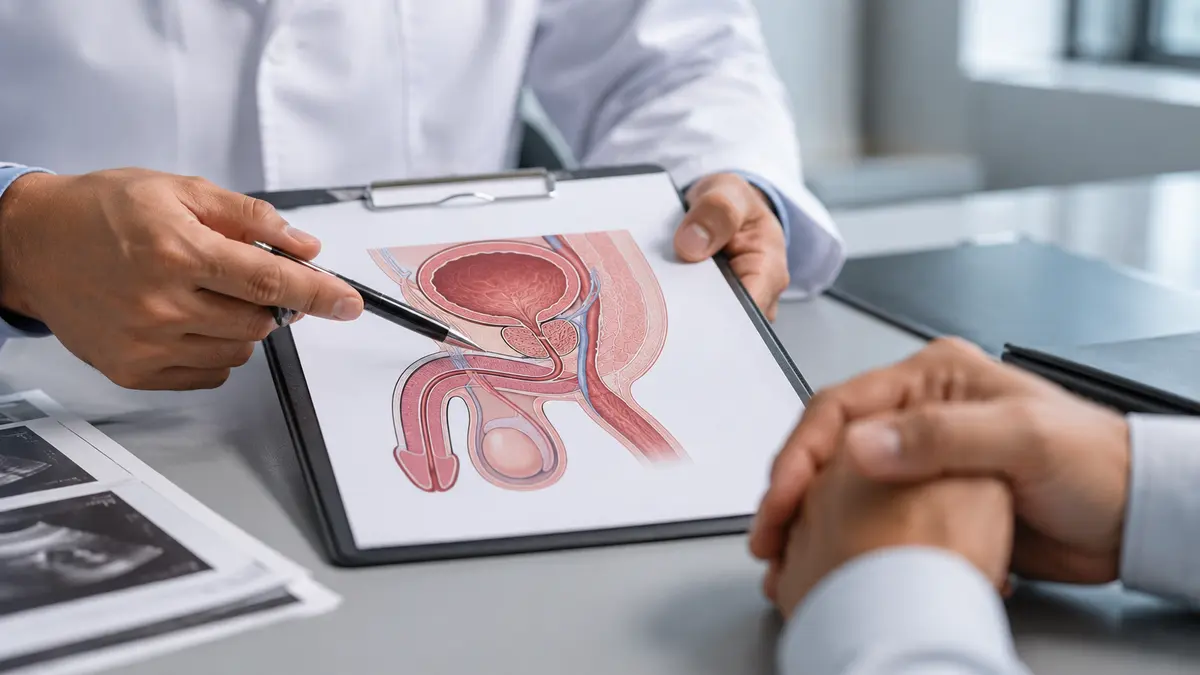
BPH at a glance:
| Question | Short answer |
|---|---|
| What it is | Non-cancerous prostate growth that squeezes the urethra |
| How common | BPH tissue in ~50% of men 51–60 and nearly 90% over 80 (autopsy data); symptoms in far fewer (NIDDK: 29–33% of men 65+) |
| Is it cancer? | No, and it doesn't raise cancer risk |
| Fastest relief | Alpha-blockers: flow can improve within days |
| Long-term shrinkage | 5-alpha reductase inhibitors: 20–25% over 6–12 months |
| Free options | Fluid timing, double voiding, cutting caffeine/alcohol |
| Do supplements work? | Evidence is limited so far; they aren't part of the AUA's treatment guideline |
What is an enlarged prostate, exactly?
The prostate is a walnut-sized gland beneath the bladder, wrapped around the urethra that carries urine out of the body. Over the decades, its cells slowly multiply and the gland grows, squeezing the urethra like a hand tightening around a hose. Doctors call this enlargement benign prostatic hyperplasia, or BPH.
The gland's job is producing part of your seminal fluid; growth doesn't change that function. "Benign" means it isn't cancer, and "hyperplasia" just means an increase in cells, not a tumor.
of men aged 51 to 60 have BPH tissue under the microscope, rising to nearly 90% of men over 80. Far fewer have symptoms: the NIDDK estimates 29% to 33% of men 65 and older.Sources: Berry et al., Journal of Urology (1984); Corona et al., International Journal of Endocrinology (2014); NIDDK (NIH)
What are the symptoms of an enlarged prostate?
BPH symptoms fall into two groups. Storage symptoms come from an irritated, overworked bladder, like nighttime urination, urgency, and frequency. Voiding symptoms come from the squeezed urethra itself, like a weak stream, hesitancy, and a bladder that never fully empties. Most men notice storage symptoms first.
- Waking at night to urinate (nocturia): usually the first and most disruptive sign. We cover it in depth in Why Do I Pee So Much at Night?
- Weak or interrupted stream: the flow starts and stops, or has lost its old strength.
- Hesitancy: you're ready, but the stream takes seconds to start.
- Urgency: sudden, hard-to-postpone need to go.
- Frequency: urinating eight or more times a day.
- Incomplete emptying: the feeling that some urine always stays behind.
- Dribbling at the end of urination.
Urologists score these with a standard questionnaire, the International Prostate Symptom Score (IPSS): seven questions, each scored 0–5. Under 8 is mild; 8–19 moderate; 20+ severe. Filling it out before your appointment gives your doctor a clear picture of how much your symptoms bother you.
What causes the prostate to enlarge?
Two ingredients are required: aging and testosterone. Men castrated before puberty never develop BPH, which is how researchers learned hormones drive the process. The leading explanation involves dihydrotestosterone (DHT), a testosterone by-product that keeps signaling prostate cells to grow even as blood testosterone falls with age.
Shifting estrogen-to-testosterone balance as men age likely plays a role too, according to the NIDDK.
Risk factors you can't change: age and family history. Risk factors you can influence: obesity, type 2 diabetes, and physical inactivity all make BPH more likely, according to the NIDDK. For the evidence behind each factor, see our full guide to what causes an enlarged prostate.

Is BPH dangerous, and is it cancer?
No, BPH is not cancer. The NIDDK explains that BPH is a non-cancerous growth, not caused by cancer. The two conditions can coexist (same gland, different diseases), which is one reason screening still matters. Studies do find prostate cancer diagnosed more often in men with BPH, which the authors of a 2016 meta-analysis link to extra testing and shared risk factors. We walk through that research in our guide to what causes an enlarged prostate.
Untreated severe BPH can cause real complications, though: urinary tract infections, bladder stones, blood in urine, bladder-muscle damage and, rarely, acute urinary retention: a sudden inability to urinate at all, which is a medical emergency.
How do doctors diagnose an enlarged prostate?
Diagnosis is usually a single visit. Doctors start with a symptom questionnaire, then a quick digital rectal exam to check the gland's size, a PSA blood test to help rule out cancer, and a urine test to rule out infection. More detailed tests follow only if needed.
- Symptom history: often using the IPSS questionnaire above.
- Digital rectal exam (DRE): ten seconds of awkwardness that tells the doctor the gland's size and texture.
- PSA blood test: mainly to help rule out cancer; BPH itself can mildly raise PSA.
- Urine test: rules out infection.
- When needed: uroflowmetry (you urinate into a measuring device) and a bladder ultrasound to check how much urine stays behind.
What actually helps?
Every option, ranked by evidence: free lifestyle changes help mild symptoms; prescription medication is the proven standard of care; supplements have more limited evidence than drugs; and minimally invasive procedures or surgery handle cases medication can't fix. Here's what each actually involves, starting with what costs nothing.
1. Lifestyle changes (free, and genuinely effective for mild symptoms)
- Time your fluids: stop drinking 2–3 hours before bed; front-load fluids earlier in the day.
- Cut caffeine and alcohol, especially after mid-afternoon; both irritate the bladder and increase urine production.
- Double void: urinate, wait 30 seconds, go again; it reduces the leftover urine that wakes you later.
- Review your medications with your doctor: decongestants and antihistamines can worsen urinary symptoms; diuretics taken at night practically schedule your 3 a.m. wake-up.
- Move and lose: regular exercise and weight loss are consistently associated with milder symptoms.

2. Prescription medication (the standard of care)
Alpha-blockers (tamsulosin, alfuzosin) relax the muscle in the prostate and bladder neck. They don't shrink anything, but flow often improves within days. 5-alpha reductase inhibitors (finasteride, dutasteride) block DHT and actually shrink the prostate by roughly 20–25%, but need 6–12 months to show full effect. Many men take both. Side effects exist for each class; that conversation belongs with your doctor.
3. Supplements (popular, but read the evidence first)
Here's where honesty matters: the American Urological Association's guideline (2021, amended 2023) doesn't include supplements among its BPH treatments, and it notes that two independent trials of saw palmetto found no benefit over placebo. The gold-standard 2023 Cochrane review reached the same conclusion about saw palmetto, the most famous ingredient; we broke down that whole story in our saw palmetto analysis. A few other ingredients, like pygeum, have limited but real positive trials. Vitamin D is a separate case: low levels are linked to larger prostates, and one small trial has tested vitamin D for BPH symptoms. Iodine, often found in liquid prostate formulas, has so far been tested only in animals; here is what that research shows and the safe daily limit. See how they compare in our evidence-first supplement ranking.
If you're considering a supplement anyway, know exactly what's in the bottle and what each ingredient's evidence looks like; that's precisely what we do in our ProstaVive review, ingredient by ingredient.
4. Minimally invasive procedures and surgery
When medication isn't enough, modern urology has an escalating menu: UroLift (tiny implants hold the prostate open), Rezūm (steam ablation of excess tissue), laser therapies, and the long-standing benchmark, TURP (surgical removal of obstructing tissue). According to the Urology Care Foundation, the less invasive options are usually done without a hospital stay and carry less risk, in exchange for more modest results than surgery such as TURP. Ask your urologist about re-treatment rates for any option you consider.
What's the bottom line?
An enlarging prostate is a near-universal part of male aging, not a verdict. Mild symptoms often respond to free habit changes. Moderate symptoms have well-proven prescription options. Severe cases have effective procedures. The only losing move is ignoring symptoms for years while your bladder quietly pays the price.
Keep reading: start with why you're waking at night, then see what the research says about saw palmetto before buying any supplement.
Frequently asked questions
Can an enlarged prostate go back to normal size?
Not on its own. BPH is progressive with age, but 5-alpha reductase inhibitors (like finasteride) can shrink the prostate by roughly 20–25% over 6–12 months, and some procedures remove or compress excess tissue. Lifestyle changes ease symptoms but don't reduce gland size.
Does an enlarged prostate mean I will get prostate cancer?
No. BPH is a non-cancerous growth; the NIDDK says it is not caused by cancer. The two conditions can exist in the same gland, which is why doctors still screen. Studies find prostate cancer diagnosed more often in men with BPH, which the authors of a 2016 meta-analysis link to extra testing and shared risk factors such as hormones, inflammation, and metabolic syndrome.
At what age does the prostate start to enlarge?
Microscopic prostate growth may begin before age 30 and is found in about 8% of men in their 30s. Under the microscope, about 50% of men aged 51 to 60 have BPH, rising to nearly 90% of men over 80. Symptoms are less common: the NIDDK estimates BPH affects 5% to 6% of men aged 40 to 64 and 29% to 33% of men 65 and older.
What is the fastest way to relieve symptoms?
The fastest-acting medical option is an alpha-blocker such as tamsulosin: flow can improve within days, with a prescription. Same-day self-help: reduce evening fluids, cut caffeine and alcohol, and double void before bed.
Do prostate supplements work for BPH?
The evidence for supplements is more limited than for prescription drugs. They aren't part of the AUA's BPH treatment guideline. Saw palmetto, the best-studied ingredient, did not outperform placebo in the 2023 Cochrane review. See our full evidence breakdown, and talk to your doctor first.
What's the fastest way to shrink an enlarged prostate?
Procedures work fastest: surgery removes prostate tissue, and water vapor therapy shrinks it, according to the NIDDK. Medicines called 5-alpha reductase inhibitors, such as finasteride, shrink the prostate gradually over months. Alpha-blockers ease symptoms sooner but don't shrink the gland. Even beta-sitosterol, the best-studied supplement ingredient, didn't reduce prostate size in its Cochrane review.
Does ejaculating help an enlarged prostate?
There's no solid evidence that it helps BPH. The best-known research looked at prostate cancer instead: in a Harvard study of nearly 32,000 men, those reporting 21 or more ejaculations a month were less likely to be diagnosed with prostate cancer than those reporting 4 to 7. That's an association, and it doesn't show ejaculation shrinks the prostate.
Does ibuprofen help an enlarged prostate?
Possibly a little, but it isn't a standard BPH treatment. A 2013 review of 3 small trials (183 men) found that NSAIDs, the drug family ibuprofen belongs to, modestly improved urinary symptoms and flow, but their long-term safety for BPH is unknown. Ask your doctor before taking them regularly; cold medicines with decongestants or antihistamines can make BPH symptoms worse.

Elizabeth Miller
Elizabeth founded The Prostate Post after watching her husband deal quietly with prostate and urinary symptoms for a long time before he was willing to try anything for it. She personally researches every ingredient and study cited on this site, checking marketing claims against the primary literature. She is not a doctor; nothing here replaces medical advice.
Sources
- NIDDK (NIH): Enlarged Prostate (Benign Prostatic Hyperplasia)
- Berry SJ, Coffey DS, Walsh PC, Ewing LL. "The development of human benign prostatic hyperplasia with age." Journal of Urology, 1984;132:474-479
- Corona G, Vignozzi L, Rastrelli G, Lotti F, Cipriani S, Maggi M. "Benign prostatic hyperplasia: a new metabolic disease of the aging male and its correlation with sexual dysfunctions." International Journal of Endocrinology, 2014
- Dai X, Fang X, Ma Y, Xianyu J. "Benign prostatic hyperplasia and the risk of prostate cancer and bladder cancer: a meta-analysis of observational studies." Medicine (Baltimore), 2016;95:e3493
- American Urological Association: "Management of Lower Urinary Tract Symptoms Attributed to Benign Prostatic Hyperplasia: AUA Guideline" (published 2021, amended 2023; PDF)
- Urology Care Foundation: BPH: Symptoms, Diagnosis & Treatment
- Cochrane Library: Serenoa repens for benign prostatic hyperplasia (2023)
- Kahokehr A, Vather R, Nixon A, Hill AG. "Non-steroidal anti-inflammatory drugs for lower urinary tract symptoms in benign prostatic hyperplasia: systematic review and meta-analysis of randomized controlled trials." BJU International, 2013;111:304-311
- Rider JR, Wilson KM, Sinnott JA, Kelly RS, Mucci LA, Giovannucci EL. "Ejaculation Frequency and Risk of Prostate Cancer: Updated Results with an Additional Decade of Follow-up." European Urology, 2016;70:974-982
- Cochrane Library: Beta-sitosterols for benign prostatic hyperplasia (1999)