Equol has a real, biologically plausible mechanism for prostate health, but thin human trial evidence. It can block the hormone most linked to prostate growth in lab research. The one randomized, placebo-controlled trial (116 men, 4 weeks) didn't confirm a benefit over placebo, though, and the smaller study often cited as proof has real limitations.
Equol and BPH at a glance:
| Question | Short answer |
|---|---|
| What is equol? | A compound gut bacteria make from soy isoflavones, but only in people whose gut bacteria can do it ("equol producers") |
| Is there a real clinical trial in men with BPH? | Yes: NCT00962390, randomized, placebo-controlled, 116 men, 4 weeks |
| Did S-equol beat placebo in that trial? | No; placebo actually had the larger drop in PSA |
| Was that trial published in a medical journal? | No; results are posted only on ClinicalTrials.gov, about 16 months after the trial ended |
| What about the study that says it improved symptoms? | A separate, much smaller pilot (18 men) with no control group, published by the researcher who holds the equol patent |
| Who are "equol producers"? | 36% of Caucasian American women studied, vs. 51% of Korean-American women; there's no direct data on men |
| Who should be cautious with it? | Men with prostate cancer, men on hormone therapy, and anyone with a thyroid condition |
What Is Equol, and Why Is It Sold for Prostate Health?
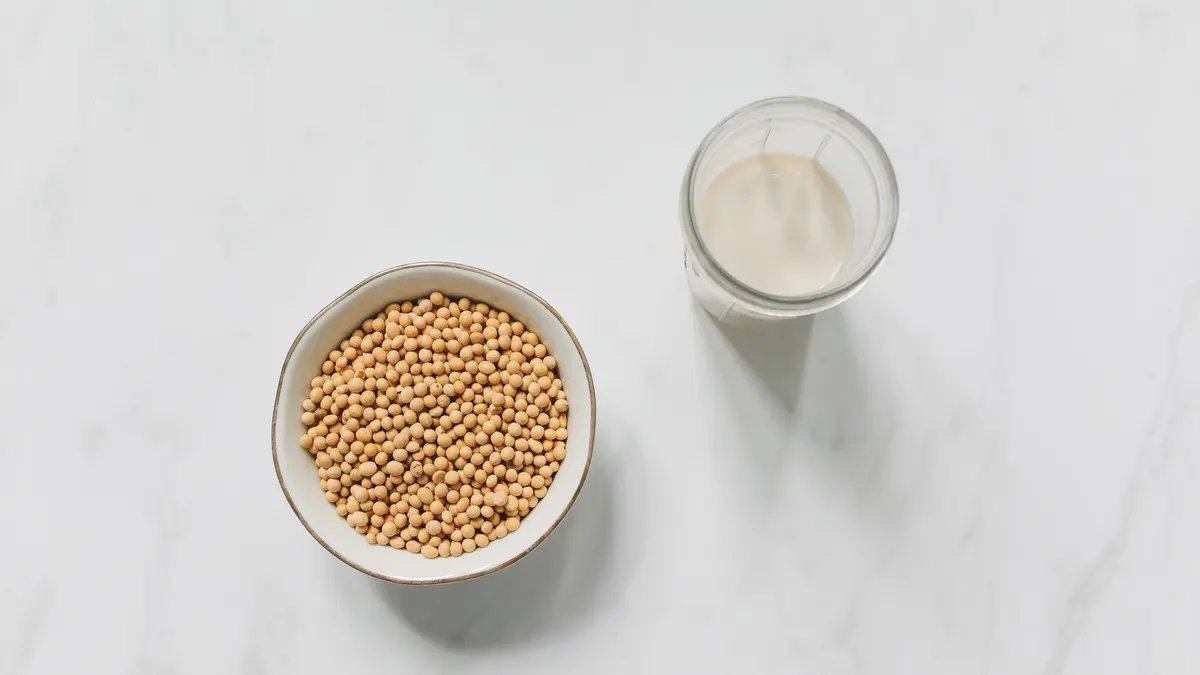
Equol is a compound your gut bacteria can make from daidzein, a soy isoflavone, though only in people whose gut bacteria can do the conversion. Researchers call those people "equol producers" and everyone else "non-producers." It's one of several soy-derived compounds now sold for BPH (benign prostatic hyperplasia), alongside better-known ingredients like saw palmetto and beta-sitosterol.
Supplements that contain S-equol directly are marketed as a way to skip that bacterial step and get the compound no matter what's living in your gut.
The biological case for equol and the prostate is genuinely interesting. Lab and animal research shows equol can bind to 5-alpha-dihydrotestosterone (DHT), the hormone most directly linked to prostate growth, and block it from acting on prostate tissue (Lund et al., Biology of Reproduction, 2004). That's a real, plausible mechanism, and it's the reason equol is worth taking seriously as a prostate ingredient. Lab findings like this don't always hold up in human trials, though, which is exactly what the next section looks at.
Does Equol Work for Prostate Health? The Clinical Trial Evidence
Equol got a proper test: a randomized, double-blind, placebo-controlled study (NCT00962390) compared three doses of S-equol against placebo in 116 men over 4 weeks, tracking change in PSA as the main measure. That's the kind of trial design this ingredient deserved.
The result: none of the three S-equol doses beat placebo, and none came close to statistical significance (p=0.47, 0.49, and 0.82 for the low, medium, and high doses). Placebo actually had the largest PSA drop of any group.
doses
None of the three S-equol doses tested (20 mg, 100 mg, or 300 mg a day) outperformed placebo on PSA change after 4 weeks in the only randomized, placebo-controlled trial of S-equol for BPH.Source: NCT00962390, ClinicalTrials.gov
This trial was sponsored by Ausio Pharmaceuticals, the company developing S-equol as a drug candidate, and it enrolled more men than any other equol-and-prostate study that exists. Its results were posted to ClinicalTrials.gov in 2017, about a year after the trial ended, but they were never published in a peer-reviewed medical journal, so a routine literature search wouldn't turn this trial up at all.
What About the Study That Says Equol Improved BPH Symptoms?
That's a real, different study, and it's the one most equol marketing actually points to. A 2013 pilot measured symptom scores in 18 men (10 with moderate BPH, 8 with severe BPH) before and after 4 weeks of equol, and reported improvement in several measures (Lephart, Open Journal of Urology, 2013). On its face, that sounds like good news.
The catch is the design: it had no placebo group and no blinding, so there's no way to know how much of that improvement would have happened anyway, since BPH symptoms naturally fluctuate week to week regardless of treatment.
It's also worth knowing where that study was published and who ran it. The journal, Open Journal of Urology, is published by Scientific Research Publishing (SCIRP), a publisher widely documented for weak peer review, and the study doesn't appear in PubMed. Its author, Edwin Lephart, discloses in a later review that he is "an inventor on polyphenolic patents (US and worldwide) on various human health applications" (Lephart, International Journal of Molecular Sciences, 2023), and Brigham Young University's technology transfer office separately confirms it holds patents on equol applications and is actively seeking to license them.
None of that means the pilot result is fabricated, and a small open-label study can still be a useful early signal. It means an 18-person study with no control group, from the patent holder, carries less weight than a randomized, placebo-controlled trial of 116 men. When the two disagree, the larger, controlled, independently sponsored trial is the one to trust.
Who Are "Equol Producers," and Does It Matter?
Only a minority of people convert soy isoflavones into equol, which is the main argument for taking S-equol directly instead of eating soy. In one prevalence study, 36% of Caucasian American women were "equol producers," versus 51% of Korean-American women (222 and 91 women) (Song et al., Journal of Nutrition, 2006).
Those numbers come from women, largely because most equol research has focused on menopause and breast cancer. There isn't a published study measuring what percentage of American men with BPH are equol producers, so a claim like "70% of men can't make equol" isn't something we could verify in a man-specific study. If you come across that framing, the honest version is that it's extrapolated from research in women, not measured directly in men.
Who Should Not Take Equol or Soy Isoflavones?
For most healthy men, equol appears to be low-risk: it's a compound found naturally in a soy-rich diet. Three specific groups should talk to a doctor first, though, because equol's mechanism works through hormone pathways: men with prostate cancer, men on hormone therapy of any kind, and men with an existing thyroid condition.
- Prostate cancer or active surveillance: equol has estrogen-receptor and anti-androgen activity, the same pathways targeted by some prostate cancer treatments. Soy isoflavones have been studied in men with prostate cancer, but that's a decision for your oncologist, not a reason to self-treat.
- Tamoxifen or other hormone therapy: the human research here is in breast cancer, not prostate cancer, and it isn't conclusive. A 2009 cohort study of over 5,000 breast cancer survivors found no harm from soy food intake, including in women on tamoxifen (Shu et al., JAMA, 2009), but an animal study found that low, diet-level doses of genistein (though not the highest dose tested) blunted tamoxifen's effect in mice (Du et al., Carcinogenesis, 2012). Anyone on hormone therapy of any kind should ask their doctor before adding an isoflavone supplement.
- An existing thyroid condition: a comprehensive safety review found that isoflavones don't appear to meaningfully affect thyroid function in most healthy adults with normal iodine intake, but flagged people with existing hypothyroidism, including subclinical cases, as the group where effects have actually been seen, including cases where thyroid hormone levels didn't fully recover after stopping (Hüser et al., Archives of Toxicology, 2018).
These are specific, identifiable situations, not a reason for every man curious about a soy-derived supplement to hold back.
So Is Equol Worth Trying?
Equol has a real, plausible mechanism and a good safety profile in healthy men, which is more than some ingredients can claim. But as a reason to expect BPH symptom relief, the trial evidence doesn't back it up yet: the one placebo trial found nothing, and the study people cite instead has real design limitations.
That's not the same as "equol doesn't work," since a single, underpowered, 4-week trial can miss a real but modest effect. It's also not the same as proof, so it's reasonable to stay curious about equol while not expecting it to be the answer on its own.
If you're comparing equol against other supplement ingredients people try for BPH, the honest picture varies a lot by ingredient. Saw palmetto has the most research but hasn't beaten placebo in the largest trial, while beta-sitosterol has smaller but more consistently positive trials. That's exactly how we approached grading equol and every other ingredient in our evidence-first supplement comparison.
Frequently asked questions
Does equol work for prostate?
Equol has a plausible biological mechanism, but the one randomized, placebo-controlled trial of S-equol for BPH (116 men, 4 weeks) found no benefit over placebo, which actually had the larger drop in PSA. A smaller pilot study cited as proof it works had no placebo group and was run by equol's patent holder.
Is there a prostate supplement that really works?
No single supplement has strong, consistent trial evidence for BPH symptoms, including saw palmetto, the most-studied one, which didn't beat placebo in a 72-week trial of 369 men. Prescription medications like alpha-blockers and 5-alpha-reductase inhibitors have the strongest evidence. Our evidence-first comparison walks through what each supplement ingredient has (and hasn't) shown in human trials.
What do urologists recommend for an enlarged prostate?
For bothersome BPH symptoms, the first-line options urologists generally reach for are prescription alpha-blockers (like tamsulosin) or 5-alpha-reductase inhibitors (like finasteride), sometimes combined with watchful waiting and lifestyle changes for milder cases. Supplements aren't part of standard urology guidelines because none has shown the same level of trial evidence.
Which supplement is best for BPH?
There isn't a clear winner backed by strong human trials. Beta-sitosterol has the most consistent small-trial evidence for symptom scores, saw palmetto has the most research overall but hasn't beaten placebo in the largest trial, and equol has one small, uncontrolled pilot study against one larger trial that found no benefit. None has evidence as strong as prescription BPH medications.

Elizabeth Miller
Elizabeth founded The Prostate Post after watching her husband deal quietly with prostate and urinary symptoms for a long time before he was willing to try anything for it. She personally researches every ingredient and study cited on this site, checking marketing claims against the primary literature. She is not a doctor, and nothing here replaces medical advice.
Sources
- ClinicalTrials.gov: "S-equol for Treatment of Men With Prostatic Hyperplasia" (NCT00962390), Ausio Pharmaceuticals, results posted 2017
- Lund TD, et al. "Equol is a novel anti-androgen that inhibits prostate growth and hormone feedback" Biology of Reproduction (2004)
- Lephart ED. "Severe and Moderate BPH Symptoms in Mid-Aged Men Improved with Isoflavonoid-Equol Treatment: Pilot Intervention Study" Open Journal of Urology, Vol. 3, No. 1 (2013) — uncontrolled pilot study, not indexed in PubMed; we could not locate the original article online for independent verification and relied on its description in Lephart's own 2023 review (below)
- Lephart ED. "Equol's Role as a Natural Nutraceutical" International Journal of Molecular Sciences (2023) — includes author's patent conflict-of-interest disclosure
- Song KB, et al. "Prevalence of daidzein-metabolizing phenotypes differs between Caucasian and Korean American women and girls" Journal of Nutrition (2006)
- Shu XO, et al. "Soy food intake and breast cancer survival" JAMA (2009)
- Du M, et al. "Low-dose dietary genistein negates the therapeutic effect of tamoxifen in athymic nude mice" Carcinogenesis (2012) — animal study
- Hüser S, et al. "Effects of isoflavones on breast tissue and the thyroid hormone system in humans: a comprehensive safety evaluation" Archives of Toxicology (2018)
- Andriole GL, et al. "The effect of increasing doses of saw palmetto fruit extract on serum prostate specific antigen: analysis of the CAMUS randomized trial" Journal of Urology (2013)
Medical disclaimer: The Prostate Post is an independent publication. Our content is for informational purposes only and is not medical advice, diagnosis, or treatment. Talk to your doctor before starting any supplement, especially if you have prostate cancer, are on hormone therapy, or have a thyroid condition. Statements about dietary supplements have not been evaluated by the Food and Drug Administration; supplements are not intended to diagnose, treat, cure, or prevent any disease.